Warehouse Automation System in Hyderabad: Types, Benefits & Applications
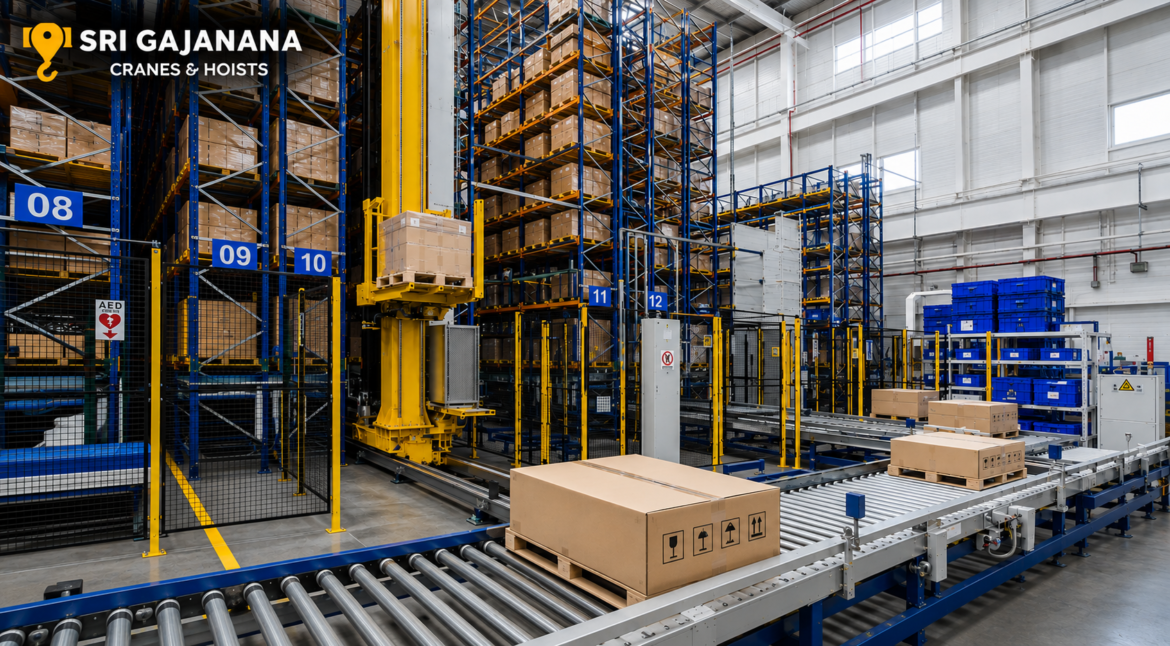
A warehouse automation system in Hyderabad uses automated equipment, material-handling technology, and control systems to improve the way goods are stored, moved, retrieved, and managed. Depending on the warehouse layout and operational requirements, automation can include Automated Storage and Retrieval Systems (ASRS), stacker cranes, conveyors, goods lifts, transfer systems, and automated control solutions.
For warehouses and manufacturing facilities handling large volumes of materials, a warehouse automation system in Hyderabad can help improve storage utilization, material flow, inventory visibility, and operational consistency. A properly designed system combines mechanical equipment with control and management technologies to create a coordinated material-handling process.
Sri Gajanana Cranes & Hoists provides customized material-handling and automation solutions based on warehouse requirements, load characteristics, available space, and operational needs.
What Is a Warehouse Automation System?
A warehouse automation system in Hyderabad is a combination of equipment, controls, and software used to automate one or more warehouse activities. These activities can include receiving, storage, movement, retrieval, sorting, and dispatch.
Instead of depending entirely on manual material movement, an automated warehouse can use equipment such as conveyors, stacker cranes, ASRS, and other material-handling systems to move products through predefined processes.
The level of automation depends on factors such as warehouse size, storage height, load capacity, SKU volume, throughput requirements, and the type of products being handled.
How Does Warehouse Automation Work?
A typical automated warehouse process can be organized into several stages:
Receiving → Identification → Storage → Retrieval → Conveying → Picking/Sorting → Dispatch
For example, when a pallet enters a warehouse, its identification information can be recorded before the material is transferred to the appropriate storage location. In an ASRS-based warehouse, automated equipment such as a stacker crane can place the pallet into a designated rack location and retrieve it when required.
Conveyors and transfer systems can then move materials between different warehouse zones. A warehouse automation system in Hyderabad can also be integrated with inventory and warehouse management systems to improve visibility and coordinate material movement.
Types of Warehouse Automation Systems
Different warehouses require different levels and types of automation. Some commonly used systems include:
1. Automated Storage and Retrieval System (ASRS)
An Automated Storage and Retrieval System (ASRS) is designed to automatically store and retrieve materials from designated storage locations.
ASRS can use stacker cranes, conveyors, transfer systems, and control software to coordinate storage and retrieval operations. These systems can be designed for pallets, bins, cable drums, paper rolls, drums, and other industrial loads.
2. Stacker Crane Systems
Stacker cranes are commonly used in high-density automated storage applications. They travel within storage aisles to place and retrieve loads from rack locations.
A stacker-crane-based system can be useful when a warehouse needs to make better use of vertical storage space while maintaining controlled material movement.
3. Warehouse Conveyor Systems
Conveyors provide a continuous method of transporting materials between different warehouse areas.
Depending on the application, warehouses may use belt conveyors, roller conveyors, chain conveyors, or other customized conveyor configurations.
Conveyors can connect receiving areas, storage systems, picking stations, production lines, and dispatch areas.
4. Goods Lift Systems
Goods lifts can be used to transfer materials between different floor levels in a warehouse or industrial facility.
They can be particularly useful in multi-level storage and production environments where materials need to move vertically between floors.
5. Transfer Trolley and Transfer Systems
Transfer trolleys can move heavy loads between predefined locations and can complement other warehouse material-handling equipment.
They can be considered where materials need to move between production areas, storage zones, or different handling stations.
Key Components of a Warehouse Automation System
A complete warehouse automation system in Hyderabad may include several interconnected components.
Storage System
Racking and storage structures provide the physical locations for pallets, bins, cartons, or other materials.
Stacker Crane or Retrieval Equipment
Automated storage systems may use stacker cranes or other retrieval equipment to place and retrieve loads.
Conveyor System
Conveyors transport materials between different processing and storage points.
7 Benefits of a Warehouse Automation System
1. Better Use of Warehouse Space
Automation can help warehouses make more effective use of available floor and vertical space. High-density storage systems such as ASRS can use vertical storage areas more effectively than conventional layouts in suitable applications.
2. Improved Material Movement
Automated conveyors, stacker cranes, and transfer systems can provide a controlled flow of materials between different warehouse zones.
3. Improved Inventory Visibility
When automation is integrated with warehouse management and control systems, businesses can improve visibility into storage locations and material movement.
4. Reduced Manual Material Handling
Automation can reduce the amount of repetitive manual movement required for suitable warehouse processes. This can allow employees to focus on supervision, picking, quality control, and other tasks.
5. Consistent Operations
Automated systems operate according to programmed sequences and defined processes, helping create more consistent material movement.
6. Improved Retrieval Efficiency
Automated storage and retrieval equipment can locate and move materials according to system instructions, reducing unnecessary searching and movement.
7. Scalable Warehouse Operations
A properly planned automation system can be designed around current operational requirements while allowing opportunities for future expansion, depending on the warehouse layout and technology selected.
Warehouse Automation System Cost in Hyderabad
The cost of a warehouse automation system in Hyderabad varies according to the size and complexity of the project. There is no single price applicable to every warehouse.
Important factors affecting the cost include:
- Warehouse dimensions
- Storage capacity
- Load capacity
- ASRS requirements
- Stacker crane configuration
- Conveyor length and type
- Number of storage locations
- Automation and control requirements
- Software integration
- Installation and commissioning
- Customization requirements
- Safety systems
For this reason, businesses should evaluate the warehouse layout and operational requirements before selecting a system.
Warehouse Automation Applications in Hyderabad
A warehouse automation system in Hyderabad can be used across several industries and applications, including:
- Manufacturing warehouses
- Automotive industries
- Engineering industries
- Pharmaceutical warehouses
- FMCG distribution
- E-commerce warehouses
- Logistics and distribution centers
- Food and beverage storage
- Spare-parts warehouses
- Industrial storage facilities
- High-density pallet storage
- Production-line material handling
The most suitable automation technology depends on the type of materials, throughput, storage requirements, and available space at each facility.
Frequently Asked Questions
What is a warehouse automation system?
A warehouse automation system uses automated equipment, controls, and software to perform or assist with storage, retrieval, movement, and inventory-related warehouse processes.
Is ASRS suitable for every warehouse?
Not necessarily. ASRS suitability depends on factors such as load type, storage capacity, throughput, warehouse height, layout, and investment requirements.
Can an existing warehouse be automated?
Yes. Automation can be considered for an existing warehouse when the building structure, layout, equipment, and operational requirements are suitable for the proposed system.
What is the difference between ASRS and warehouse automation?
ASRS is one type of warehouse automation. Warehouse automation is a broader term that can include ASRS, conveyors, stacker cranes, transfer systems, controls, software, and other automated material-handling technologies.
How much does warehouse automation cost in Hyderabad?
The cost depends on warehouse size, storage capacity, equipment, load requirements, automation level, software integration, installation, and customization. A project-specific assessment is required to determine the actual cost.
Can warehouse automation improve storage space utilization?
It can, particularly when high-density storage technologies such as ASRS and stacker cranes are appropriate for the warehouse. The actual improvement depends on the existing layout and proposed system design.
Does warehouse automation require software integration?
Not every automation project requires the same level of software integration. Larger automated systems can use WMS, WCS, or other control and management interfaces to coordinate warehouse operations.
Conclusion
A warehouse automation system in Hyderabad can combine storage, material handling, conveying, and control technologies to create a more organized and efficient warehouse operation.
ASRS, stacker cranes, conveyors, goods lifts, transfer systems, and automation controls can each serve different purposes within a warehouse. The right combination depends on the facility’s storage requirements, load characteristics, throughput, available space, and future plans.
Sri Gajanana Cranes & Hoists can help businesses evaluate their material-handling requirements and develop customized solutions for industrial warehouse applications.
Looking for a warehouse automation system in Hyderabad? Contact Sri Gajanana Cranes & Hoists to discuss your warehouse layout, material-handling requirements, and automation needs.
👉 Stay connected with us for updates, crane demos, and safety tips: